Physics Tutoring
Our online Physics tutoring is built around matching you with the right tutor
Physics tutors are typically undergraduates/graduates of degrees such as Astrophysics, Chemical Physics, Mechanical Engineering, Physics, Theoretical Physics, Mathematics and Physics. Most Physics tutors have straight A grades up to Advanced Higher level and are achieving 1st averages.
We offer Physics tutoring at S1-2, National 4, National 5, Higher, Advanced Higher and University level. Other qualifications available upon request.
National 5 Physics tutoring focuses on building secure understanding of core principles while developing confidence with calculations and exam-style problem solving. Lessons are adapted to the student’s current level, whether they need targeted support with specific topics or more structured revision across the full course.
Topics covered
Topics commonly covered include:
- Speed, acceleration and motion
- Forces, Newton’s laws and energy
- Scalars and vectors
- Projectiles and space physics
- Electric charge, voltage and current
- Practical electricity and Ohm’s Law
- Electronics and electrical power
- Properties of matter, specific heat capacity and gas laws
- Waves, wave properties and refraction
- The electromagnetic spectrum
- Radiation and nuclear physics
Common challenges at National 5
Students often need support with:
- Selecting the correct equation rather than attempting to use every formula they remember.
- Rearranging equations accurately and managing unit conversions consistently.
- Explaining cause-and-effect relationships in written answers rather than describing surface features.
- Applying Newton’s laws correctly in unfamiliar contexts.
- Interpreting circuit diagrams and predicting changes to current and voltage.
- Linking graphical data, calculations and written reasoning into coherent exam responses.
National 5 Physics Assignment
National 5 Physics includes a mandatory assignment which contributes to the overall course award. The assignment assesses a student’s ability to apply physics knowledge within a practical investigation, analyse data and draw supported conclusions.
Support can include:
- Understanding what the assignment is assessing and how marks are allocated
- Processing experimental data accurately, including calculations and graph work
- Explaining relationships between variables using correct physics terminology
- Structuring clear conclusions and evaluations based on evidence
- Support focuses on developing skills and understanding
Higher Physics requires deeper conceptual understanding and the ability to apply equations and physical principles accurately in unfamiliar contexts. Lessons are more analytical than National 5, with greater emphasis on multi-step calculations, graphical interpretation and structured written explanations.
Unit 1: Motion, Forces and Energy
Topics commonly covered include:
- Motion equations and graphs
- Vectors and acceleration
- Balanced and unbalanced forces
- Free body diagrams
- Energy, work and power
- Momentum, collisions and impulse
- Gravitation and satellites
Students often need support with:
- Selecting and applying the correct kinematic equations confidently.
- Interpreting and analysing motion and force–time graphs accurately.
- Resolving forces into components and constructing clear free body diagrams.
- Explaining conservation of energy and momentum in structured exam responses.
Unit 2: Particles, Fields and Radiation
Topics commonly covered include:
- The standard model and fundamental particles
- Electric and magnetic fields
- Radioactivity and nuclear reactions
- Wave–particle duality
- Diffraction and interference
- Refraction and spectra
Students often need support with:
- Explaining abstract particle physics concepts clearly rather than memorising definitions.
- Applying field equations to unfamiliar situations.
- Interpreting diffraction and interference patterns accurately.
- Linking experimental evidence to theoretical models in extended answers.
Unit 3: Electricity and Electronics
Topics commonly covered include:
- Alternating current and r.m.s. values
- Current, potential difference and resistance
- Internal resistance and power
- Capacitors
- Semiconductors and band theory
- p–n junctions, LEDs and solar cells
Students often need support with:
- Rearranging and applying circuit equations confidently in multi-step problems.
- Analysing complex circuits including series, parallel and potential dividers.
- Explaining semiconductor behaviour using band theory.
- Linking theoretical circuit behaviour to practical measurements and experiments.
Higher Physics Assignment
Higher Physics includes a mandatory assignment which contributes to the final course award. The assignment assesses a student’s ability to apply physics knowledge within a practical investigation, analyse data and draw supported conclusions.
Support can include:
- Understanding what the assignment is assessing and how marks are allocated
- Processing and presenting experimental data clearly, including calculations and graph work
- Linking conclusions directly to underlying physics principles
- Writing structured evaluations using accurate scientific terminology
- Support focuses on developing skills and understanding
Advanced Higher Physics demands high-level mathematical fluency and the ability to apply complex theoretical models to unfamiliar and abstract situations. Students are expected to derive relationships, justify assumptions and construct rigorous, logically structured solutions. Lessons focus on conceptual understanding, precise mathematical reasoning and clear scientific communication at a pre-university standard.
Unit 1: Mechanics
Topics commonly covered include:
- Kinematic relationships in one and two dimensions
- Angular velocity and angular acceleration
- Centripetal force and rotational dynamics
- Relativistic motion and relativistic energy
Students often need support with:
Deriving equations confidently rather than memorising results.
Connecting linear and angular motion relationships accurately.
Applying conservation laws in multi-step mechanics problems.
Explaining relativistic effects clearly alongside calculations.
Unit 2: Quanta and Waves
- Topics commonly covered include:
- Wave–particle duality
- Interference and diffraction
- Polarisation
- Introduction to quantum theory
- Atomic models and uncertainty principles
Students often need support with:
- Linking experimental evidence to quantum models logically.
- Interpreting interference and diffraction mathematically.
- Explaining abstract quantum concepts clearly and precisely.
- Applying wave relationships confidently in unfamiliar contexts.
Unit 3: Electromagnetism
Topics commonly covered include:
- Electric force and electric fields
- Electric potential and motion of charged particles
- Magnetic fields and forces on moving charges
- Electromagnetic radiation
- Capacitors and inductors in a.c. circuits
- Students often need support with:
- Analysing charged particle motion using vector reasoning.
- Applying field equations accurately in multi-step problems.
- Connecting electromagnetic theory to practical circuit behaviour.
- Structuring extended written solutions clearly and logically.
Our Process
How Matching Works
Finding the right tutor shouldn’t feel like guesswork. We take the time to understand your needs, recommend the most suitable tutor, and support you as you go – so you can focus on progress, not admin.
Step 1: Understanding What’s Needed
A short conversation or message helps us identify:
- What you are hoping tutoring will achieveSubject and level
- Areas the student would like support with
- Availability for lessons
Step 2. Recommending a Suitable Tutor
We suggest a tutor based on:
- Availability that allows consistent lessons
- Experience with the relevant qualification level
- Ability to explain the subject clearly
- A teaching approach suited to the student
Step 3: Lessons Begin
Once timings are agreed, lessons start and continue on a regular basis that suits the student. There is no long-term contract, so families can decide how long they would like tutoring to continue. If circumstances change, we can help adjust arrangements where appropriate.
Why us
Why Caledonia Tutors
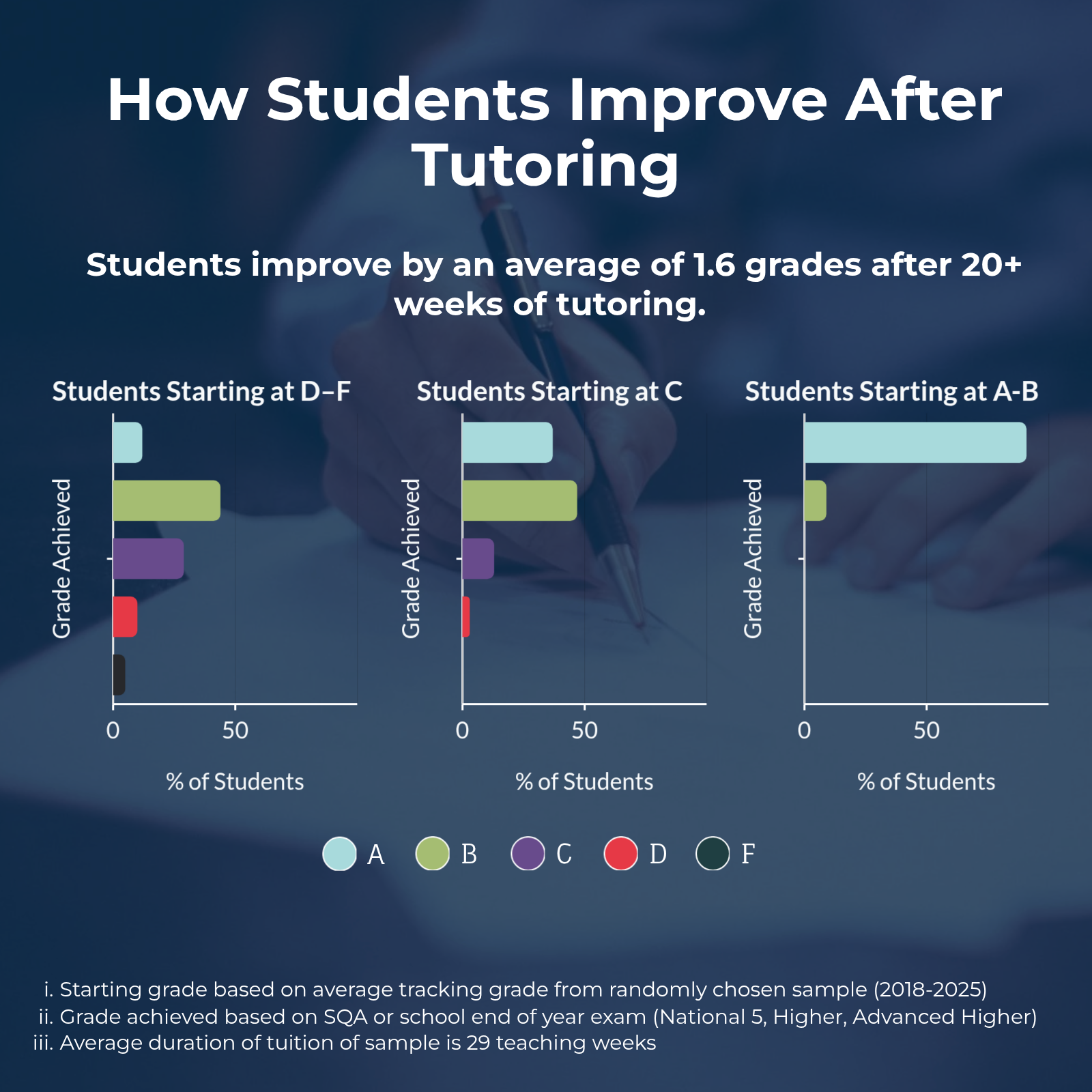
We’re proud of what we’ve achieved so far. Here are a few key figures that show the impact we’re making:
Simple, Transparent Pricing
We aim to keep pricing clear and transparent, with options to suit different subjects and study levels. See our latest pricing and how it works.
Find a Physics Tutor
If you would like us to recommend a tutor, simply get in touch and let us know the subject, level, and any preferred timings. We will come back to you with a suitable option and the next steps.
Complete the form below to begin the process of finding a tutor