Chemistry Tutoring
Our online Chemistry tutoring is built around matching you with the right tutor
Chemistry tutors are typically undergraduates/graduates of degrees such as Biochemistry, BSc Chemistry, MChem Chemistry, PhD Chemistry, Chemical Physics, Chemical Engineering, Medicine, Medicinal and Biological Chemistry. Most Chemistry tutors have straight A grades up to Advanced Higher level and are achieving 1st averages.
We offer Chemistry tutoring at S1-2, National 4, National 5, Higher, Advanced Higher and University level. Other qualifications available upon request.
National 5 Chemistry tutoring focuses on developing secure understanding of core chemical principles while building confidence with calculations and exam-style problem solving. Lessons are tailored to the student’s current level, whether they need targeted support with specific topics such as reaction rates or acids and bases, or structured revision across the full course.
Topics covered
- 1.1 Acids, Bases and pH
- 1.2 Atoms, Elements and Compounds
- 1.3 Mass, Volume and Concentration
- 1.4 Reaction Rates
- 2.1 Consumer Products
- 2.2 Energy of Fuels
- 2.3 Fuels and Hydrocarbons
- 3.1 Fertilisers
- 3.2 Metals
- 3.3 Nuclear Chemistry
- 3.4 Plastics
Common challenges at National 5
National 5 Chemistry students often struggle with:
- Understanding the fundamentals of Chemistry
- Interpreting data, graphs and tables
- Calculation-based questions
- ‘Using your knowledge of Chemistry’ questions
- Managing time effectively in exams, particularly for Section 2
National 5 Chemistry Assignment
The National 5 Chemistry assignment contributes to the overall course award and assesses a student’s ability to apply chemical knowledge within a practical investigation. Students must gather and analyse data, apply relevant chemical principles and communicate findings clearly.
Common difficulties include structuring calculations accurately, linking conclusions to chemical theory and evaluating experimental limitations.
Tutors support students in developing the analytical and reporting skills required, including data interpretation and structured scientific explanation.
Higher Chemistry requires a deeper conceptual understanding and the ability to apply chemical principles accurately in unfamiliar contexts. Lessons are more analytical than National 5, with greater emphasis on multi-step calculations, data interpretation, and structured written explanations.
Unit 1: Chemical Changes and Structure
Topics commonly covered include:
- Reaction Rates and Collision Theory
- Reaction Profiles and Activation Energy
- Catalysis
- The Periodic Table and Periodicity
- Bonding and Structure
- Intermolecular Forces
Students often need support with:
- Linking collision theory to energy profile diagrams rather than treating them as separate topics.
- Interpreting reaction rate and periodic trend data accurately.
- Distinguishing clearly between bonding types and relating bonding to physical properties.
- Explaining intermolecular forces and structural effects in structured extended answers.
Unit 2: Nature’s Chemistry
Topics covered include:
- Esters
- Fats, Oils and Proteins
- Chemistry of Cooking and Food
- Oxidation and Antioxidants
- Consumer Chemistry (Soaps, Detergents and Emulsions)
- Fragrances and Cosmetic Chemistry
Students often need support with:
- Drawing and naming organic structures accurately.
- Recognising reaction patterns rather than memorising isolated examples.
- Explaining oxidation and reduction in organic contexts.
- Linking molecular structure to properties such as boiling point and solubility.
Unit 3: Chemistry in Society
Topics covered include:
- Getting the Most from Reactants
- Chemical Equilibria
- Chemical Energy
- Redox Chemistry
- Chromatography
- Volumetric Analysis
Students often need support with:
- Completing multi-step mole and reacting volume calculations accurately.
- Explaining percentage yield and atom economy clearly and concisely.
- Applying Le Chatelier’s principle to unfamiliar equilibrium scenarios.
- Constructing balanced ion-electron equations and interpreting titration data precisely.
Higher Chemistry Assignment
Higher Chemistry includes a mandatory assignment which contributes to the final course award. Support can include:
- Understanding what the assignment is assessing and how marks are awarded
- Processing, analysing and presenting experimental data clearly
- Structuring calculations and linking conclusions to relevant chemical principles
- Writing precise discussions and evaluations using accurate chemical terminology
- Support focuses on developing skills and understanding
Unit 1: Inorganic and Physical Chemistry
Topics commonly covered include:
- Electromagnetic radiation and atomic spectra
- Atomic orbitals and electronic configurations
- Shapes of molecules and polyatomic ions
- Transition metals and complex chemistry
Students often need support with:
- Explaining quantum ideas clearly rather than memorising definitions.
- Applying electronic configuration principles to unfamiliar elements.
- Interpreting spectroscopic data accurately.
- Linking structure, bonding and energy concepts in extended answers.
Unit 2: Organic Chemistry
- Topics commonly covered include:
- Molecular orbitals and bonding theory
- Stereochemistry and isomerism
- Reaction mechanisms and synthesis pathways
- Experimental determination of structure
Students often need support with:
- Using curly arrow notation accurately and confidently.
- Predicting reaction mechanisms rather than recalling examples.
- Distinguishing between different types of stereoisomerism.
- Interpreting IR, NMR and mass spectra to deduce structure.
Unit 3: Analytical and Physical Chemistry
- Topics commonly covered include:
- Gravimetric and volumetric analysis
- Practical laboratory techniques
- Stoichiometric calculations
- Chemical equilibrium
- Reaction feasibility and thermodynamics
- Kinetics
Students often need support with:
- Completing multi-step thermodynamic and equilibrium calculations.
- Applying entropy and free energy concepts logically.
- Determining rate equations and reaction order from data.
- Connecting theoretical chemistry to practical laboratory techniques.
Advanced Higher Chemistry Assignment
The project consists of an independently researched investigation. Students must select a chemistry topic, gather and process data, apply relevant Advanced Higher theory, and produce a structured scientific report including analysis and evaluation.
Support can include:
- Understanding what the project is assessing and how marks are awarded
- Refining a focused and appropriate research question
- Designing a clear, feasible method or analytical approach
- Processing and analysing complex data accurately
- Linking conclusions directly to relevant chemical principles
- Writing precise evaluations that meaningfully address uncertainty and limitations
- Support focuses on developing independence, analytical thinking and scientific communication.
Our Process
How Matching Works
Finding the right tutor shouldn’t feel like guesswork. We take the time to understand your needs, recommend the most suitable tutor, and support you as you go – so you can focus on progress, not admin.
Step 1: Understanding What’s Needed
A short conversation or message helps us identify:
- What you are hoping tutoring will achieveSubject and level
- Areas the student would like support with
- Availability for lessons
Step 2. Recommending a Suitable Tutor
We suggest a tutor based on:
- Availability that allows consistent lessons
- Experience with the relevant qualification level
- Ability to explain the subject clearly
- A teaching approach suited to the student
Step 3: Lessons Begin
Once timings are agreed, lessons start and continue on a regular basis that suits the student. There is no long-term contract, so families can decide how long they would like tutoring to continue. If circumstances change, we can help adjust arrangements where appropriate.
Why us
Why Caledonia Tutors
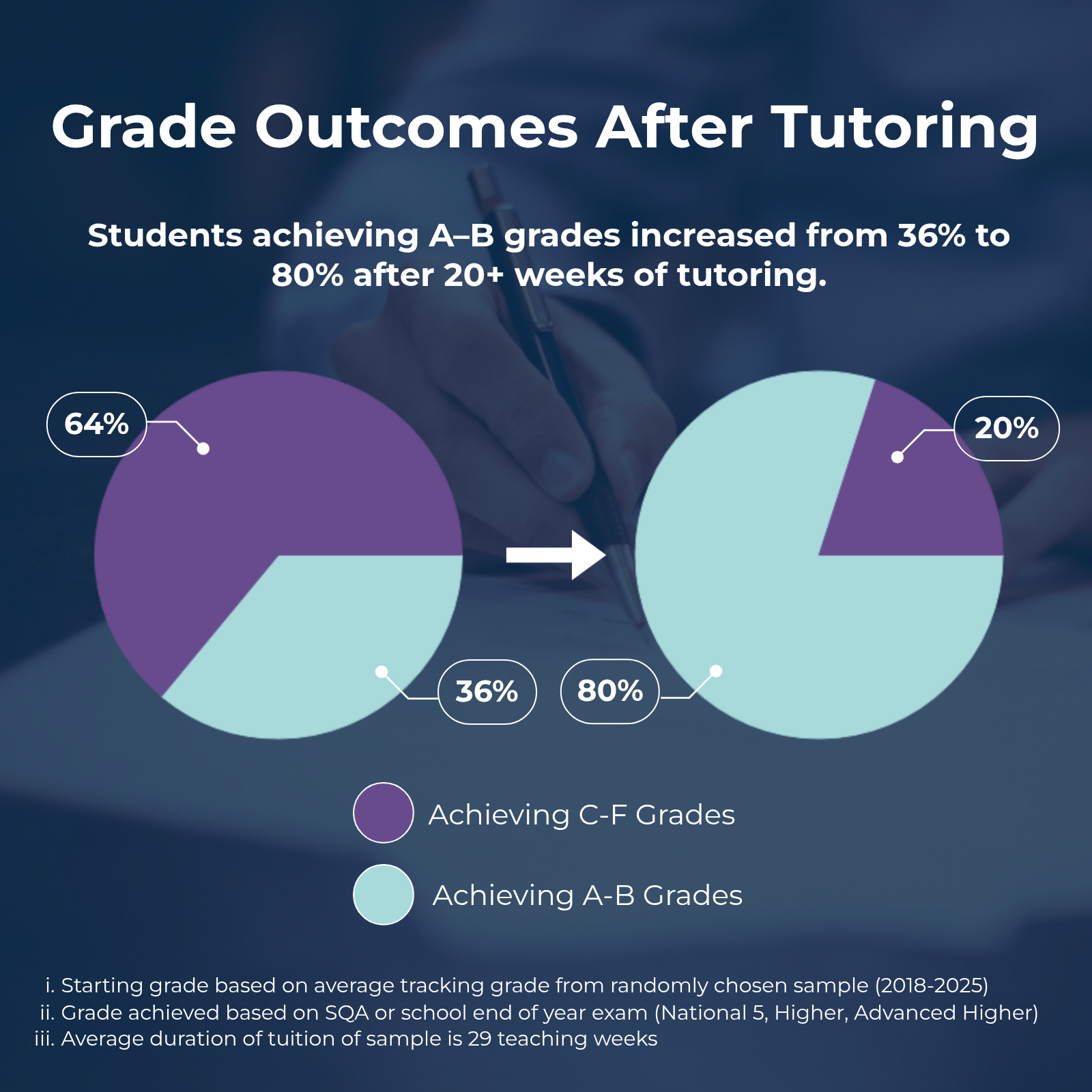
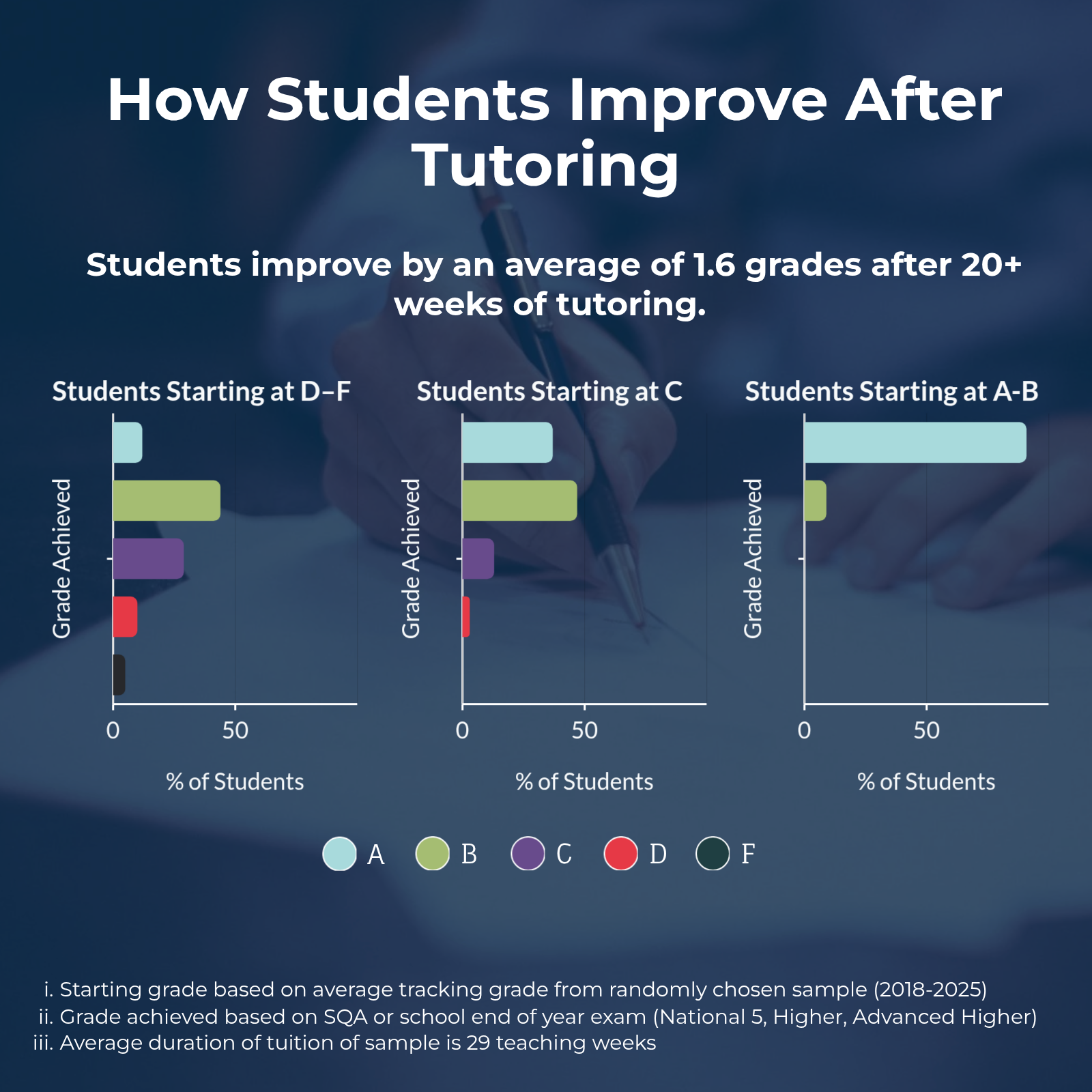
We’re proud of what we’ve achieved so far. Here are a few key figures that show the impact we’re making:
Simple, Transparent Pricing
We aim to keep pricing clear and transparent, with options to suit different subjects and study levels. See our latest pricing and how it works.
Find a Chemistry Tutor
If you would like us to recommend a tutor, simply get in touch and let us know the subject, level, and any preferred timings. We will come back to you with a suitable option and the next steps.
Complete the form below to begin the process of finding a tutor