Maths Tutoring
Our online Maths tutoring is built around matching you with the right tutor.
Maths tutors are typically undergraduates/graduates of degrees such as Mathematics, Civil Engineering, Mechanical Engineering, Mathematics and Physics, Mathematics and Philosophy and Economics. Most Maths tutors have straight A grades up to Advanced Higher level and are achieving 1st averages.
We offer Maths tutoring at Primary, S1-2, National 4, National 5, Higher, Advanced Higher and University level. Other qualifications available upon request.
National 4 Maths focuses on building secure numeracy and problem-solving skills, while developing confidence with algebra, geometry and data handling. The course is assessed internally and does not include a final exam. Students must pass all units and complete an Added Value Unit.
Assessment
- Numeracy Unit (internal assessment)
- Expressions and Formulae Unit (internal assessment)
- Relationships Unit (internal assessment)
- Added Value Unit – Application of Maths (problem-solving task)
Key Areas of the Course
- Fractions, decimals, percentages and ratio
- Negative numbers, rounding and significant figures
- Money and finance (including tax, hire purchase and foreign exchange)
- Measurement, unit conversions and practical numeracy
- Data handling and interpretation
- Algebraic expressions and simplifying
- Substitution into formulae and changing the subject
- Solving equations
- Expanding brackets
- Working with straight line graphs
- Angles and geometric properties
- Coordinates, gradients and straight lines
- Pythagoras and basic trigonometry
- Area, volume and scale drawing
- Sequences and number patterns
Added Value Unit
- Extended problem-solving task
- Application of skills from across the course
- Multi-step reasoning and interpretation
Students often need support with:
- Building confidence with core numeracy skills
- Translating worded problems into clear mathematical steps
- Working accurately without losing marks through small errors
- Understanding algebra rather than memorising procedures
- Interpreting graphs and data correctly
- Applying skills across different topics in the Added Value Unit
Students working towards National 4 often develop at different speeds. In some cases, learners may complete aspects of National 5 content alongside National 4, particularly where they are close to the National 5 standard.
National 5 Mathematics tutoring focuses on strengthening core algebraic and numerical skills while developing confidence with multi-step problem solving. Lessons are adapted to the student’s current level, whether they need targeted support with specific topics or structured revision across the full course.
Topics covered include:
- Algebraic fractions and expanding brackets
- Factorising and completing the square
- Equations, inequalities and simultaneous equations
- Changing the subject of a formula
- Indices and surds
- Quadratics, parabolas and the quadratic formula
- Functions and straight line graphs
- Trigonometry, sine and cosine rules
- Trigonometric equations, graphs and identities
- Vectors
- Percentages and fractions
- Scientific notation
- Pythagoras and similar shapes
- Arcs, sectors and shapes within circles
- Bearings, triangle area and Volume
- Statistics
Students often need support with:
- Selecting appropriate methods rather than attempting trial-and-error approaches.
- Interpreting worded problems and translating them into correct mathematical models.
- Managing accuracy and avoiding small errors that cost marks.
- Applying trigonometry, quadratics, circle geometry and bearings confidently in unfamiliar problem contexts.
- Linking algebraic methods to graphical representations, particularly with straight lines, functions and parabolas.
- Structuring multi-step reasoning clearly in non-calculator and problem-solving questions.
Higher Mathematics demands greater fluency in algebra and calculus, along with the ability to apply methods accurately in unfamiliar and multi-step contexts. Lessons focus on developing confidence with abstract reasoning, structured working and exam-level problem solving, not just procedural competence.
Topics commonly covered include:
- Polynomials and quadratics
- Functions and graphs of functions
- Straight lines
- Circles
- Exponential and logarithmic functions
- Trigonometric formulae and equations
- Vectors
- Recurrence relations
- Differentiation (including optimisation and rates of change)
- Integration and area under a curve
- Further calculus techniques
- Wave function
Students often need support with:
- Linking algebraic processes to graphical behaviour, particularly with functions and transformations.
- Understanding differentiation conceptually rather than treating it as a memorised rule set.
- Applying integration correctly and interpreting areas in context.
- Handling multi-step calculus problems such as optimisation.
- Working confidently with logarithms and exponentials without procedural confusion.
- Managing algebraic complexity in recurrence relations, trig identities and polynomial manipulation.
Advanced Higher Mathematics demands confident algebraic control and the ability to think logically across extended, multi-step problems. The course moves beyond standard techniques and focuses on proof, structured reasoning and combining ideas from different areas of mathematics within a single question. Lessons emphasise clarity of argument, precision of working and genuine conceptual understanding.
Topics commonly covered include:
- Properties of functions and advanced graph analysis
- Differentiation and further differentiation
- Integration and further integration
- Differential equations
- Sequences and series, including further series methods
- Binomial theorem
- Partial fractions
- Complex numbers
- Matrices and systems of equations
- Vectors
- Further number theory
- Methods of proof
Students often need support with:
- Constructing clear and logically sound proofs rather than relying on memorised methods.
- Managing algebraic complexity across multi-stage calculus and differential equation problems.
- Working confidently with formal notation in sequences, series and functions, particularly when generalising or proving results.
- Working confidently with complex numbers in both algebraic and geometric form.
- Interpreting questions involving functions, derivatives and integrals in extended, unfamiliar problems.
- Maintaining precision in extended solutions where small logical gaps can cost marks.
Our Process
How Matching Works
Finding the right tutor shouldn’t feel like guesswork. We take the time to understand your needs, recommend the most suitable tutor, and support you as you go – so you can focus on progress, not admin.
Step 1: Understanding What’s Needed
A short conversation or message helps us identify:
- What you are hoping tutoring will achieveSubject and level
- Areas the student would like support with
- Availability for lessons
Step 2. Recommending a Suitable Tutor
We suggest a tutor based on:
- Availability that allows consistent lessons
- Experience with the relevant qualification level
- Ability to explain the subject clearly
- A teaching approach suited to the student
Step 3: Lessons Begin
Once timings are agreed, lessons start and continue on a regular basis that suits the student. There is no long-term contract, so families can decide how long they would like tutoring to continue. If circumstances change, we can help adjust arrangements where appropriate.
Why us
Why Caledonia Tutors
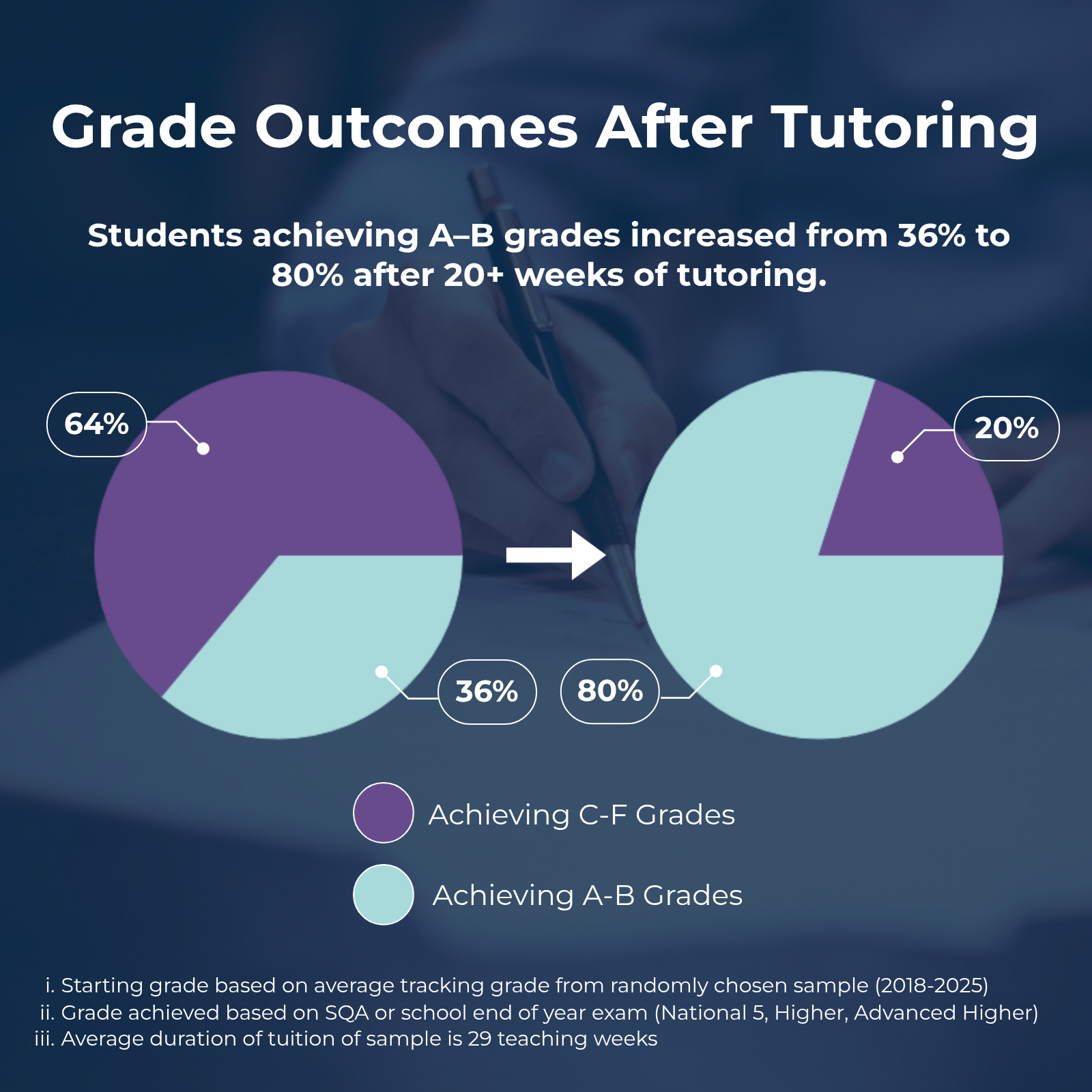
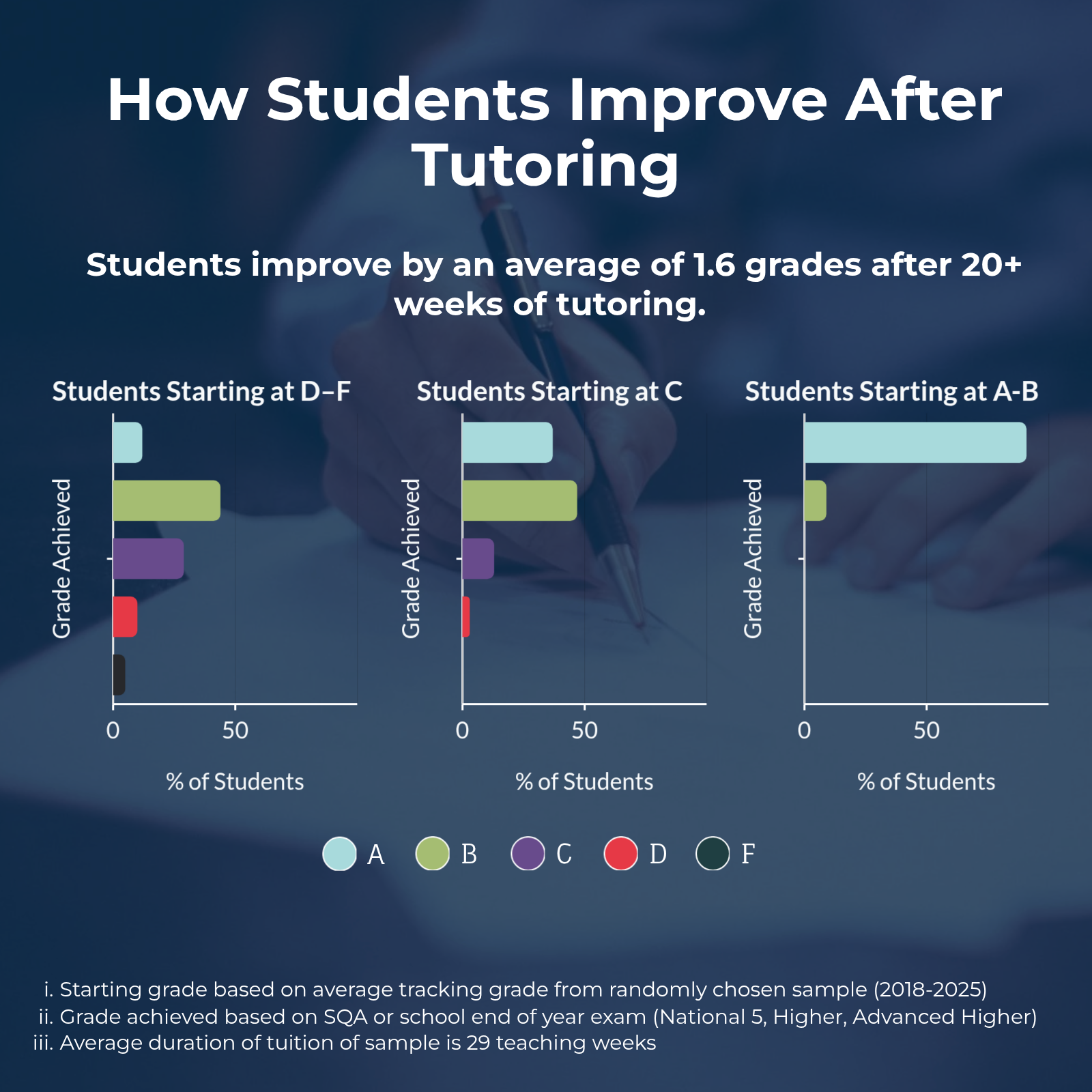
We’re proud of what we’ve achieved so far. Here are a few key figures that show the impact we’re making:
Simple, Transparent Pricing
We aim to keep pricing clear and transparent, with options to suit different subjects and study levels. See our latest pricing and how it works.
Find a Maths Tutor
If you would like us to recommend a tutor, simply get in touch and let us know the subject, level, and any preferred timings. We will come back to you with a suitable option and the next steps.
Complete the form below to begin the process of finding a tutor